Book view
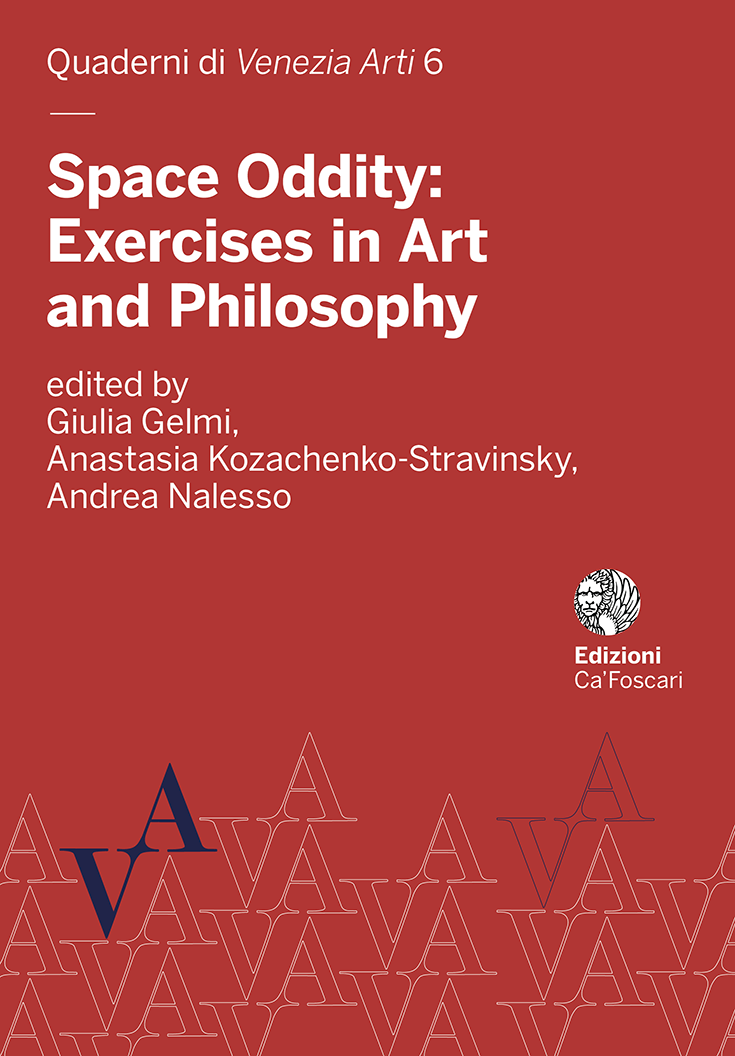
Space Oddity: Exercises in Art and Philosophy
Edited by Giulia Gelmi, Anastasia Kozachenko-Stravinsky, Andrea Nalesso
Book information
- Publisher
- Edizioni Ca' Foscari
- Publication
- Published 21 December 2022
- Place
- Venice, Italy
- Series
- Quaderni di <i>Venezia Arti</i>
- Catalogue record
- View in the catalogue
Abstract
The volume includes papers presented at the 4th Postgraduate International Conference of the Department of Philosophy and Cultural Heritage of Ca’ Foscari University of Venice (Venice, 5-7 October 2022). Our understanding of reality is filtered through myriad media, and we have the ability – and power – to gather, ignore, tweak, and explore the information needed to define what we mean by ‘reality’. The concept of ‘space’ – in its broadest sense – plays an essential role in an individual’s explanation of reality, and we must deal with a plurality of models and concepts of it. As elaborated in the text Space and Time in Art, the Russian theologian, philosopher, and art theorist Pavel Florensky states: “all culture can be interpreted as the activity of organising space”. Starting from this culturological reading, Florensky identifies three spatial “dimensions” and three corresponding genres of activity: (1) The space of our strong relations and the activity of ‘Technique’; (2) The mental space and its organisation and the activities of ‘Science’ or ‘Philosophy’; (3) The space between the previous two, and the activity of ‘Art’. Ultimately, all have the same aim: to change reality to reconstruct space. According to leading scholars and critics, the late 1980s saw a “spatial turn” take place in literary, social, and cultural studies. In 1991 Fredric Jameson theorised a shift from the paradigm of time to the paradigm of space, from modernism to postmodernism. The pandemic era has refocused investigation on the present paradigm, where Florensky’s spaces have been concentrated through cyberspace almost overnight. Through the notion of the ‘semiosphere’ – as elaborated by Juri Lotman 100 years ago – we collectively pondered the question: “should we reconsider the concept of space as a cultural category altogether?”.
Where its authors and editors are based
Countries of the institutions the book's authors, editors and chapter authors were affiliated to when it was published.
- AUTHORS / EDITORS
- CITATIONS Phase 2
- USAGE Phase 3
| Country | Authors / editors |
|---|---|
| Italy | 3 |
About this data
These figures cover 1 work. Each value comes from the most trusted source that has it; a correction made by OJC or OBC staff outranks every source.
| Source | Confidence | Works |
|---|---|---|
| Thoth | 90 / 100 | 1 |
| Works with a publication date | 100% |
|---|---|
| Works with a DOI | 100% |
| Works with a funder recorded | 0% |
| Authors with an affiliation | 100% |
| Affiliations matched to an institution (ROR) | 100% |
| Affiliations with a country | 100% |
Countries come from the institution each author was affiliated to when they published, as recorded in ROR. A country is never guessed, so authors without a matched institution are not counted on the maps.
Funders come from OpenAlex for articles and Thoth for books, where publishers recorded them. Most works record none, so a funder's figures show what is recorded, not everything it funded.
Chapters count as works: their authors and editors, and the countries of their institutions, are in every figure where Thoth records an affiliation for them.
Citations (Phase 2) and usage (Phase 3) are not collected yet.