Book view
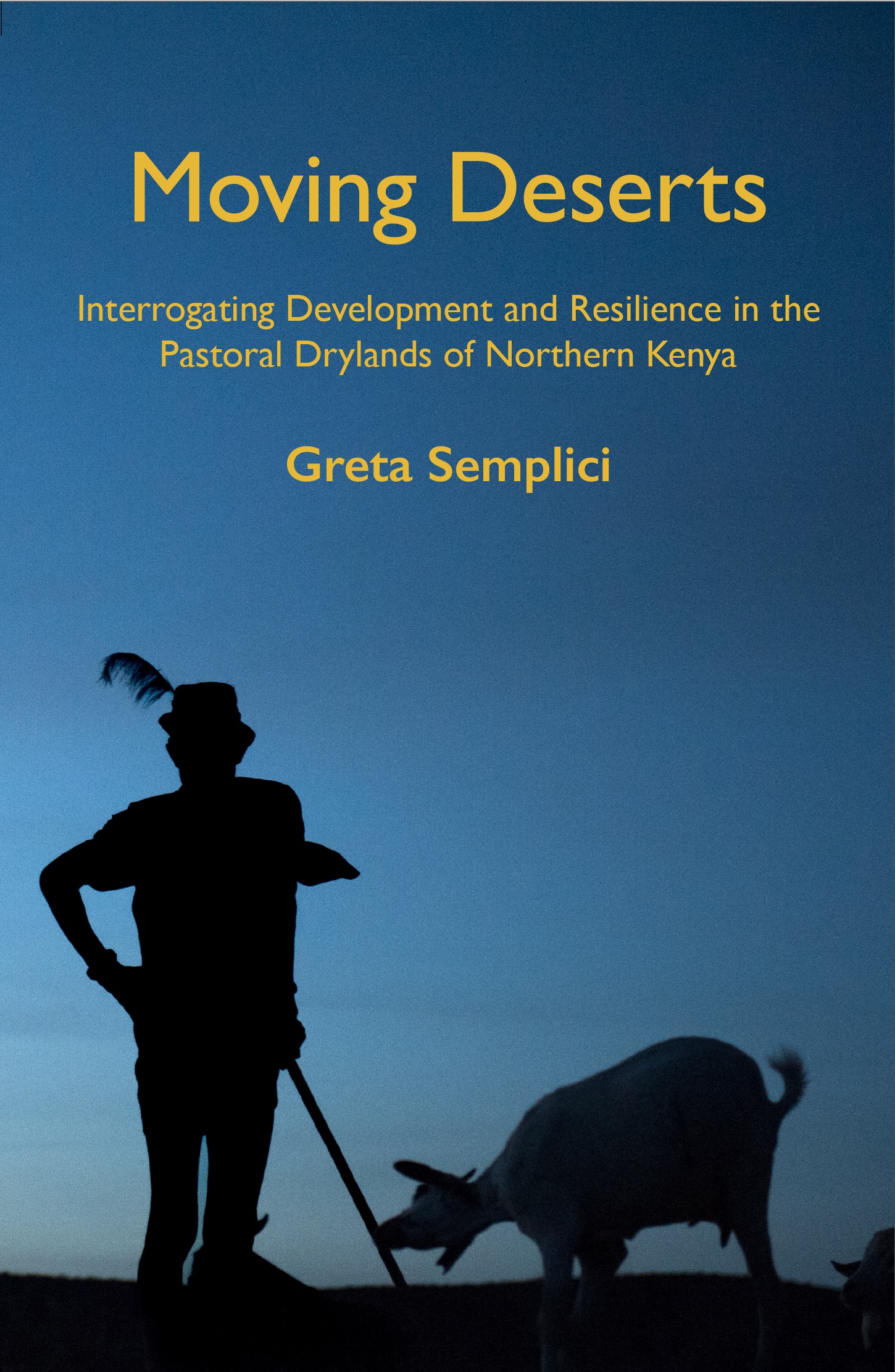
Moving Deserts
Interrogating Development and Resilience in the Pastoral Drylands of Northern Kenya
Book information
- Publisher
- White Horse Press
- Publication
- Published 15 October 2025
- Place
- Winwick, Cambs., UK
- Catalogue record
- View in the catalogue
Abstract
Moving Deserts re-examines the concept of resilience, as applied in the development sector. It gives central stage to the voices, experiences, memories and everyday lives of the people whose resilience is the subject of much international attention and financial aid flows. Building a bridge between the perspectives of practitioners and local communities, Moving Deserts reveals a story about life, struggle and hope among Turkana herders, a story woven by following the movements and relations of the author's hosts and interlocutors during fourteen months of ethnographic fieldwork. The volume argues that it is in their very mobility that the meaning of resilience resides: mobility as physical movements to reach ephemeral and unevenly spread resources; mobility as social connections to weave a social fabric that also works as safety net; mobility as fluid identities, never static but plastic, capable of taking on new shapes and adapting to changes. The drylands and their inhabitants, largely pastoral populations, are the spine of the book. Drylands often fall in the imaginary of the remote, the deserted, the unproductive, a powerful imaginary rooted in romantic narratives, as well as in political and economic interests. At a time of rising alarm about climate change, mass migrations and energy requirements, drylands are returning to the international stage with a focus on building resilience. This book asks what we can learn about ‘pastoral development’, currently discussed in the international development regime under the label of resilience, by switching perspective and following pastoralists’ lived experiences?
Where its authors and editors are based
Countries of the institutions the book's authors, editors and chapter authors were affiliated to when it was published.
- AUTHORS / EDITORS
- CITATIONS Phase 2
- USAGE Phase 3
| Country | Authors / editors |
|---|---|
| Italy | 1 |
About this data
These figures cover 1 work. Each value comes from the most trusted source that has it; a correction made by OJC or OBC staff outranks every source.
| Source | Confidence | Works |
|---|---|---|
| Thoth | 90 / 100 | 1 |
| Works with a publication date | 100% |
|---|---|
| Works with a DOI | 100% |
| Works with a funder recorded | 100% |
| Authors with an affiliation | 100% |
| Affiliations matched to an institution (ROR) | 100% |
| Affiliations with a country | 100% |
Countries come from the institution each author was affiliated to when they published, as recorded in ROR. A country is never guessed, so authors without a matched institution are not counted on the maps.
Funders come from OpenAlex for articles and Thoth for books, where publishers recorded them. Not every work records one, so a funder's figures show what is recorded, not everything it funded.
Chapters count as works: their authors and editors, and the countries of their institutions, are in every figure where Thoth records an affiliation for them.
Citations (Phase 2) and usage (Phase 3) are not collected yet.