Book view
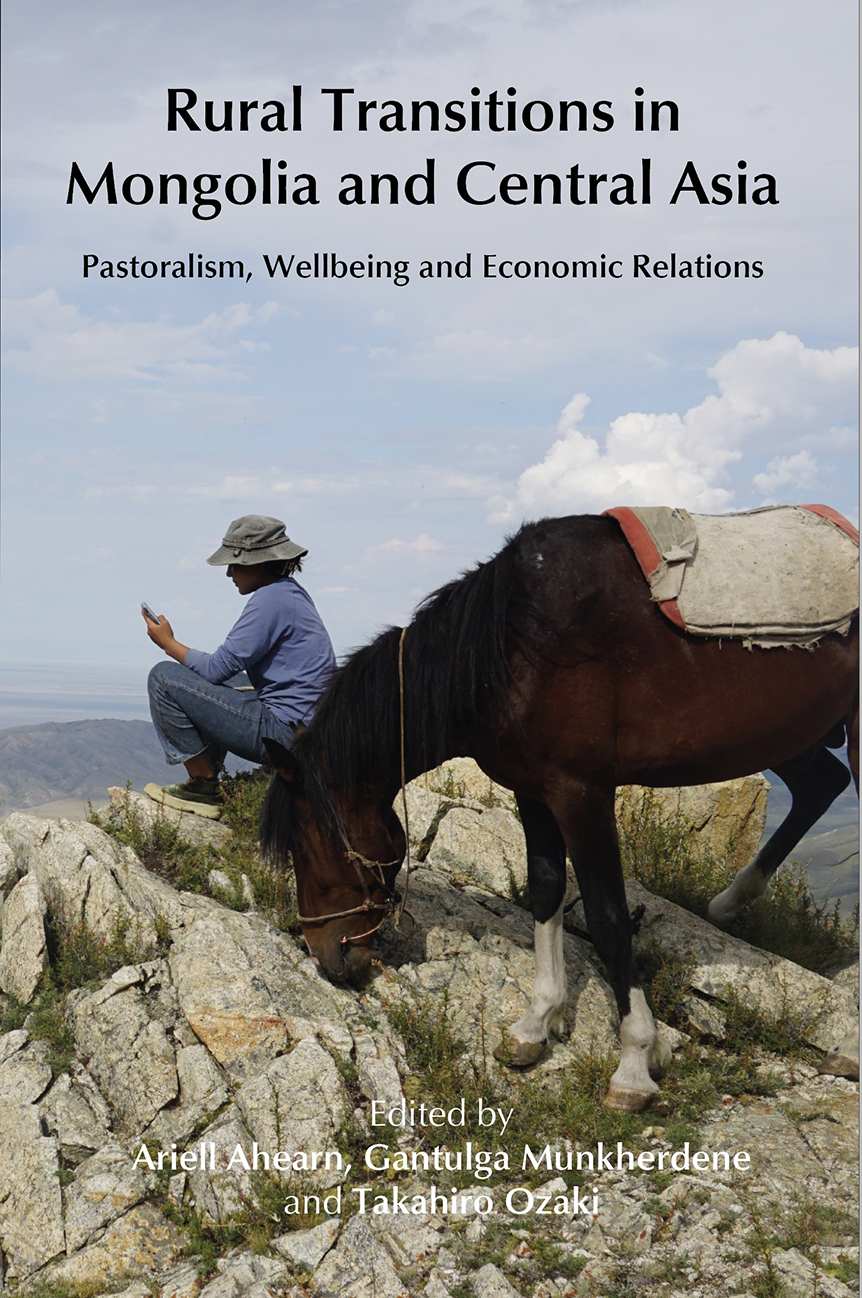
Rural Transitions in Mongolia and Central Asia
Pastoralism, Wellbeing and Economic Relations
Edited by Ariell Ahearn, Gantulga Munkherdene, Takahiro Ozaki
Book information
- Publisher
- White Horse Press
- Publication
- Published 15 February 2026
- Place
- Winwick, Cambs.
- Catalogue record
- View in the catalogue
Abstract
Focusing on pastoral and rural communities, this volume highlights ongoing transitions in rural Central Asia. Informed by in-depth case studies from Mongolia, Buryatia and Kyrgyzstan, the essays focus on themes in contemporary pastoralism, including the adaptation and resilience of rural pastoralist livelihoods during and after the Covid-19 pandemic; healing, food and wellbeing, including an examination of rural experiences of wellbeing and the re-invention and revival of traditional foods; and economic relations, including changing spatialisation of labour spurred by mineral extraction, the role of digital media and urban-rural dynamics. The volume presents insights into contemporary human geography and anthropology of the Inner Asian region; highlights the ongoing importance of scholarship on rural places; and offers a critical lens on broader processes of change affecting the region. A collaboration between scholars spanning Japan, Mongolia, Kyrgyzstan, the UK and the USA, the volume showcases work by diverse authors with longstanding engagement in Inner Asia.
Chapters
Where its authors and editors are based
Countries of the institutions the book's authors, editors and chapter authors were affiliated to when it was published.
- AUTHORS / EDITORS
- CITATIONS Phase 2
- USAGE Phase 3
| Country | Authors / editors |
|---|---|
| Japan | 6 |
| United Kingdom | 4 |
| Mongolia | 3 |
| Kyrgyzstan | 2 |
| United States | 2 |
| Belgium | 1 |
| Switzerland | 1 |
About this data
These figures cover 16 works. Each value comes from the most trusted source that has it; a correction made by OJC or OBC staff outranks every source.
| Source | Confidence | Works |
|---|---|---|
| Thoth | 90 / 100 | 16 |
| Works with a publication date | 100% |
|---|---|
| Works with a DOI | 100% |
| Works with a funder recorded | 6% |
| Authors with an affiliation | 96% |
| Affiliations matched to an institution (ROR) | 100% |
| Affiliations with a country | 100% |
Countries come from the institution each author was affiliated to when they published, as recorded in ROR. A country is never guessed, so authors without a matched institution are not counted on the maps.
Funders come from OpenAlex for articles and Thoth for books, where publishers recorded them. Most works record none, so a funder's figures show what is recorded, not everything it funded.
Chapters count as works: their authors and editors, and the countries of their institutions, are in every figure where Thoth records an affiliation for them.
Citations (Phase 2) and usage (Phase 3) are not collected yet.