Book view
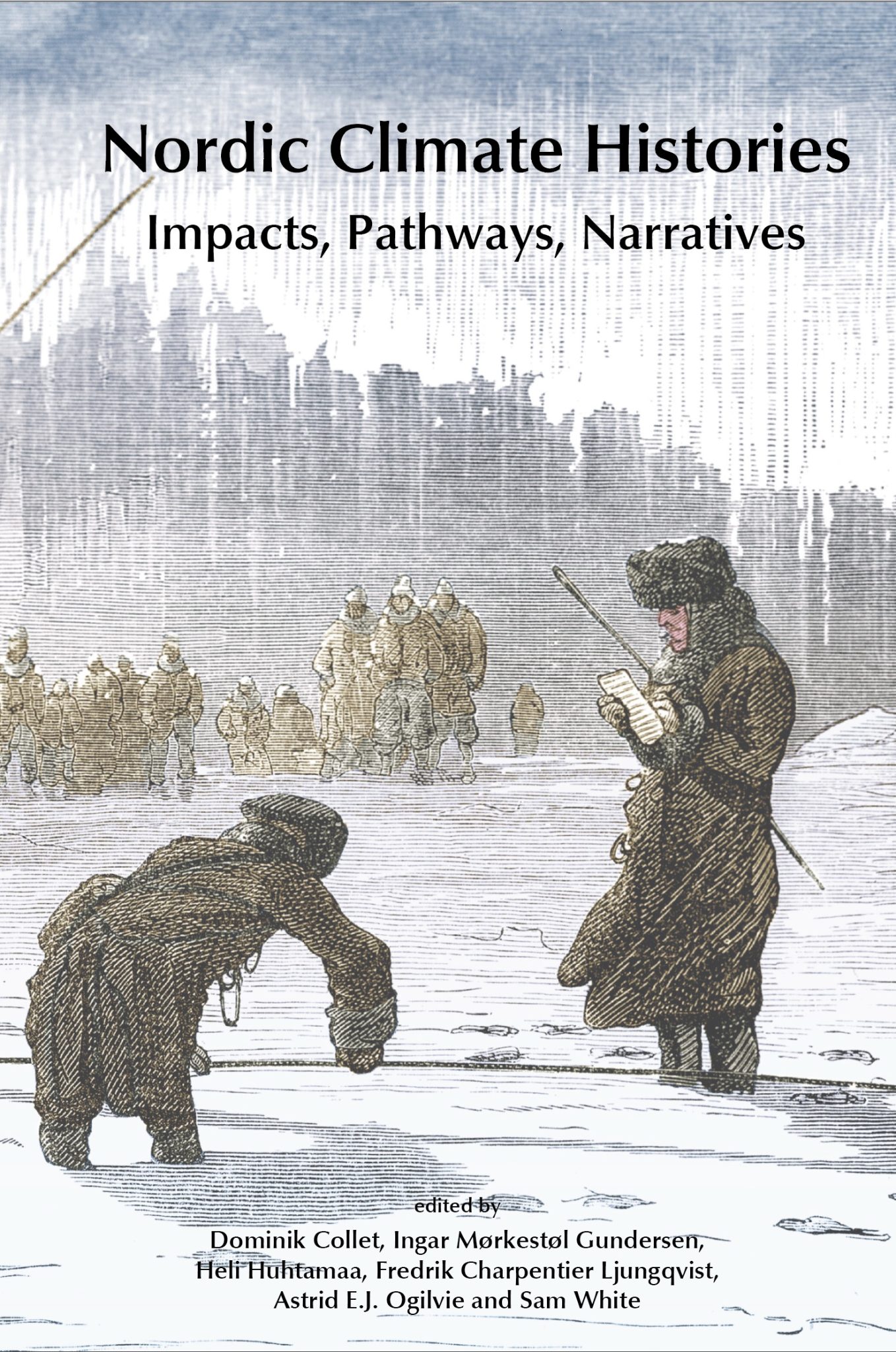
Nordic Climate Histories
Impacts, Pathways, Narratives
Edited by Dominik Collet, Ingar Mørkestøl Gundersen, Heli Huhtamaa, Fredrik Charpentier Ljungqvist, Astrid Ogilvie, Sam White
Book information
- Publisher
- White Horse Press
- Publication
- Published 15 August 2025
- Place
- Winwick, Cambs.
- Catalogue record
- View in the catalogue
Abstract
Down the centuries, the people of the Nordic countries have confronted challenges from climatic variability and change and sought ways to survive and adapt. In a time of accelerating global warming, these climate histories take on new contemporary significance. Drawing on tools from the natural and historical sciences, the innovative scholarship in this volume addresses questions such as: How did Nordic societies cope with past climatic hazards? What was the historical significance of the ‘Little Ice Age’ or the ‘Medieval Climate Anomaly’ for Nordic countries? And how do we study, narrate and learn from these past experiences?
This volume is the first to collect climate histories from across all the Nordic countries. It combines research from climatologists, historians, archaeologists and museologists to explore how climate and culture interacted in the past and what we might learn from these interactions today.
The chapters range from in-depth case studies to reflexive meta-histories; cover periods from the Bronze Age to the present; and draw on sources from tree rings to material culture to poetry. They also discuss how these histories can be communicated today, including how museums and literature can bring them into conversation with a current audience looking for lived experiences of climate adaptation.
The volume was conceived during an international conference at the University of Oslo in May 2024. This interdisciplinary forum connected leading scholars in the field with practitioners and stakeholders. The essays presented here engage a rapidly growing field of intense public and political concern in the Nordics and beyond.
The book speaks to various academic communities (climatology, history, literature) and stakeholders (museum practitioners, climate communicators and advocates). It includes the growing research and student community invested in this topic across several disciplines, practitioners and communicators in the field and the wider public interested in the vibrant debates about climate adaptation and experience.
Chapters
Where its authors and editors are based
Countries of the institutions the book's authors, editors and chapter authors were affiliated to when it was published.
- AUTHORS / EDITORS
- CITATIONS Phase 2
- USAGE Phase 3
| Country | Authors / editors |
|---|---|
| Norway | 12 |
| Finland | 2 |
| Iceland | 2 |
| Sweden | 2 |
| Switzerland | 2 |
| United States | 2 |
| Denmark | 1 |
| Ireland | 1 |
All 10 countries
| Country | Authors / editors |
|---|---|
| Norway | 12 |
| Finland | 2 |
| Iceland | 2 |
| Sweden | 2 |
| Switzerland | 2 |
| United States | 2 |
| Denmark | 1 |
| Ireland | 1 |
| Poland | 1 |
| Portugal | 1 |
About this data
These figures cover 16 works. Each value comes from the most trusted source that has it; a correction made by OJC or OBC staff outranks every source.
| Source | Confidence | Works |
|---|---|---|
| Thoth | 90 / 100 | 16 |
| Works with a publication date | 100% |
|---|---|
| Works with a DOI | 100% |
| Works with a funder recorded | 6% |
| Authors with an affiliation | 100% |
| Affiliations matched to an institution (ROR) | 96% |
| Affiliations with a country | 98% |
Countries come from the institution each author was affiliated to when they published, as recorded in ROR. A country is never guessed, so authors without a matched institution are not counted on the maps.
Funders come from OpenAlex for articles and Thoth for books, where publishers recorded them. Most works record none, so a funder's figures show what is recorded, not everything it funded.
Chapters count as works: their authors and editors, and the countries of their institutions, are in every figure where Thoth records an affiliation for them.
Citations (Phase 2) and usage (Phase 3) are not collected yet.