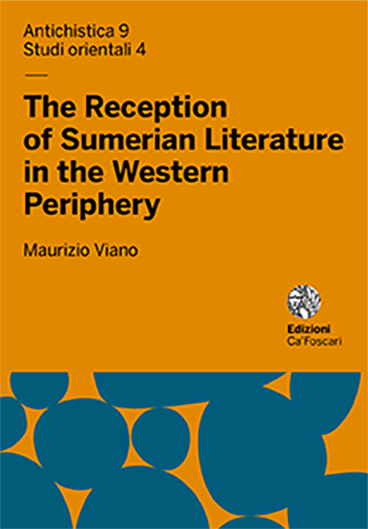
Book information
- Publisher
- Edizioni Ca' Foscari
- Publication
- Published 8 July 2016
- Place
- Venice, Italy
- Series
- Antiquity Studies
- Catalogue record
- View in the catalogue
Abstract
This book investigates the transmission of Sumerian literature to Syria and Anatolia (i.e. the Western periphery) during the Late Bronze Age. Sumerian is the most ancient language so far documented and remained for about three millennia the language of culture in Mesopotamia for its association with scribal education. With the end of the Old Babylonian period, Sumerian literary and lexical texts were disseminated to regions outside Mesopotamia. The volume, however, is not limited to the documentation stemming from peripheral sites but also includes a comprehensive study of contemporary Mesopotamian sources, i.e. Middle Babylonian and Middle Assyrian. Sumerian literature is best known through the Old Babylonian texts, to which countless studies were dedicated, while the subsequent period is poorly known and has been neglected by scholars for the scarcity of sources. Nevertheless, the Late Bronze Age is extremely important for the Sumerian literature because the process of selection and modification of texts that ended up in the first millennium canonization started in this period. Therefore, this book aims at filling a gap in our comprehension of the history of Sumerian literature. The primary objective of this book is the identification of the tradition of texts discovered in the Western periphery in comparison with second and first millennium Mesopotamian sources. The subject has been approached from different perspectives, taking into account philological, cultural, and historical aspects.
Where its authors and editors are based
Countries of the institutions the book's authors, editors and chapter authors were affiliated to when it was published.
- AUTHORS / EDITORS
- CITATIONS Phase 2
- USAGE Phase 3
| Country | Authors / editors |
|---|---|
| Italy | 1 |
About this data
These figures cover 1 work. Each value comes from the most trusted source that has it; a correction made by OJC or OBC staff outranks every source.
| Source | Confidence | Works |
|---|---|---|
| Thoth | 90 / 100 | 1 |
| Works with a publication date | 100% |
|---|---|
| Works with a DOI | 100% |
| Works with a funder recorded | 0% |
| Authors with an affiliation | 100% |
| Affiliations matched to an institution (ROR) | 100% |
| Affiliations with a country | 100% |
Countries come from the institution each author was affiliated to when they published, as recorded in ROR. A country is never guessed, so authors without a matched institution are not counted on the maps.
Funders come from OpenAlex for articles and Thoth for books, where publishers recorded them. Most works record none, so a funder's figures show what is recorded, not everything it funded.
Chapters count as works: their authors and editors, and the countries of their institutions, are in every figure where Thoth records an affiliation for them.
Citations (Phase 2) and usage (Phase 3) are not collected yet.