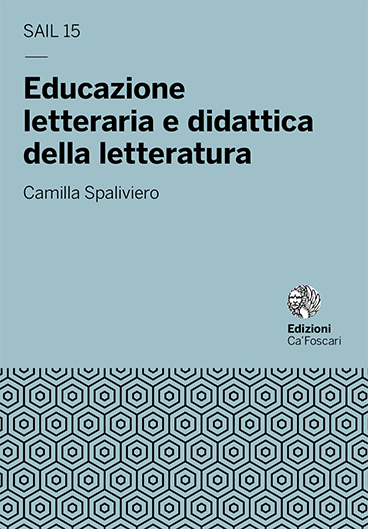
Book information
- Publisher
- Edizioni Ca' Foscari
- Publication
- Published 10 November 2020
- Place
- Venice, Italy
- Series
- SAIL
- Catalogue record
- View in the catalogue
Abstract
Literary education and language education are connected by a relationship of mutual exchange. On the one hand, without the mastery of appropriate language skills it is impossible to grasp the complexity of literary works. On the other, improving language competence is one of the multiple aims of literary education. Moreover, considering the current multicultural dimension of the Italian school system, teaching literature from an intercultural perspective provides an opportunity to foster the development of relational skills while discussing the meaning of the works. In this scenario, we explore the state of the art of literary education and the teaching of literature in Italy and we consider their implications with language education, intercultural education, and intercultural communication. Furthermore, we present both a model of literary and intercultural communicative competence and a hermeneutic and relational method, also aimed at improving language acquisition and promoting intercultural awareness. In our view, literary and intercultural communicative competence makes it possible to communicate effectively in events where the language is spoken in order to understand literary texts, to identify the original meanings, to discuss their significance from the students’ current perspective, and to formulate critical judgements. The aim of the volume is to offer content and methodological resources for the teaching of literature that can impact positively on the development of language and relational skills. Thus, we draw up some guidelines aimed at increasing students’ motivation for studying the works, fostering their active participation and allowing literature to preserve its educational function.
Where its authors and editors are based
Countries of the institutions the book's authors, editors and chapter authors were affiliated to when it was published.
- AUTHORS / EDITORS
- CITATIONS Phase 2
- USAGE Phase 3
| Country | Authors / editors |
|---|---|
| Italy | 1 |
About this data
These figures cover 1 work. Each value comes from the most trusted source that has it; a correction made by OJC or OBC staff outranks every source.
| Source | Confidence | Works |
|---|---|---|
| Thoth | 90 / 100 | 1 |
| Works with a publication date | 100% |
|---|---|
| Works with a DOI | 100% |
| Works with a funder recorded | 0% |
| Authors with an affiliation | 100% |
| Affiliations matched to an institution (ROR) | 100% |
| Affiliations with a country | 100% |
Countries come from the institution each author was affiliated to when they published, as recorded in ROR. A country is never guessed, so authors without a matched institution are not counted on the maps.
Funders come from OpenAlex for articles and Thoth for books, where publishers recorded them. Most works record none, so a funder's figures show what is recorded, not everything it funded.
Chapters count as works: their authors and editors, and the countries of their institutions, are in every figure where Thoth records an affiliation for them.
Citations (Phase 2) and usage (Phase 3) are not collected yet.